
I am a seismology student interested in earthquake hazards and earthquake early warning systems. My career goal is to help advance EEW in the U.S. and around the world.
RESEARCH PROJECTS
Solving Near-Fault Data Scarcity Using Earthquake Simulations to Improve Seismic Hazard Analysis of Normal Faults
August 2024 - present
For my first PhD project, I am analyzing the hazards of normal-faulting earthquakes. Because these earthquakes are less common than events of different fault mechanisms, like strike-slip, ground motion data for normal-slip events is more scarce. This may have an impact on our current understanding of hazards, as hazard models rely on such data.
One way to mitigate this issue is by using synthetic data from earthquake simulations. In my project, I aim to use SeisSol, a software tool for earthquake simulations, to compare the ground motion behaviors of normal faults in dynamic rupture simulations with real ground motion data.
View the SCEC 2026 poster for this project and additional content View the AGU 2025 poster for this project and additional content View the slides I presented at SSA 2026 for this project Visit the GitHub repository for my simulation data analysis code Visit the GitHub repository for my ground motion data analysis codeNote: as this is a project in progress, the code found in the repositories is not final, and may not have been polished for readability yet.
Deciphering the Hayward Fault's Recurrence Interval
February 2024 - August 2024
For my last undergrad research project at UC Berkeley I developed a workflow in a Jupyter Notebook for recreating the Monte Carlo simulation of the recurrence interval of the Hayward Fault, as published in Parsons (2008).
The goal for this project was to find if the 16-year period since the method had been applied to the Hayward Fault was statistically significant enough to yield a better fitting value for the recurrence interval. Since the last earthquake on the Fault occurred in 1868 (over 150 years ago), and the recurrence interval is thought to be close to that, we considered 16 years to be a statistically significant wait.
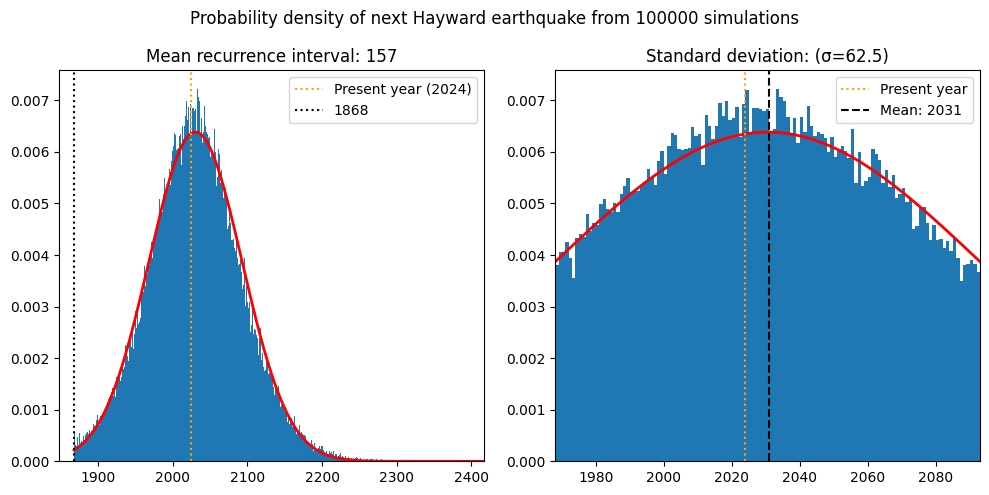
Example of results from a run of thousands of simulations using previously published error bounds for recurrence intervals (see code in repository for details).
Heartbeat of a Volcano: Detecting Seismicity in the Valles Caldera, New Mexico, Using Machine Learning
May 2023 - August 2023
This project was my URISE (now known as RESESS) undergraduate intern project. I developed a Python workflow to analyze geophone array records taken in 2019 to assess the level of activity in the Valles Caldera, New Mexico.
To analyze seismicity in the caldera, I employed Seisbench, a machine learning library for seismic phase detection. Using detection models trained on different datasets, we generated P and S wave picks which we would use to create a catalogue of earthquakes in the geophone array data. However, we found that the geophone data was full of noise from summer thunderstorms in the caldera, especially from lightning strikes. While we could not create a comprehensive earthquake catalog from this data, we were able to present conclusions about the reliability of current machine learning models for earthquake phase picking at AGU 2023 in San Francisco.
Visit my Earthscope intern spotlight page View the AGU abstract for this project View the AGU poster for this projectUnfortunately, the code for this project is not publicly available.
The Earthquake Traffic Light
October 2022 - May 2023
My first undergrad research project at UC Berkeley involved creating a workflow for analyzing spatiotemporal changes in b-value in the San Francisco Bay Area. We used data from the Northern California Seismic Network to calculate b-values in the area dating to 1984. The goal of this project was to test a method proposed by Gulia & Wiemer (2019) that would distinguish foreshocks from mainshocks and aftershocks in real time. If successful, this method would be useful for assessing real-time hazard analysis when a moderately large earthquake occurs, as it would provide a way to determine if a mainshock will follow it. However, in our execution, the method proved unsuccessful due to a scarcity of sufficiently large (M>6.0) earthquakes in our dataset.
Visit the GitHub repository for this project.